

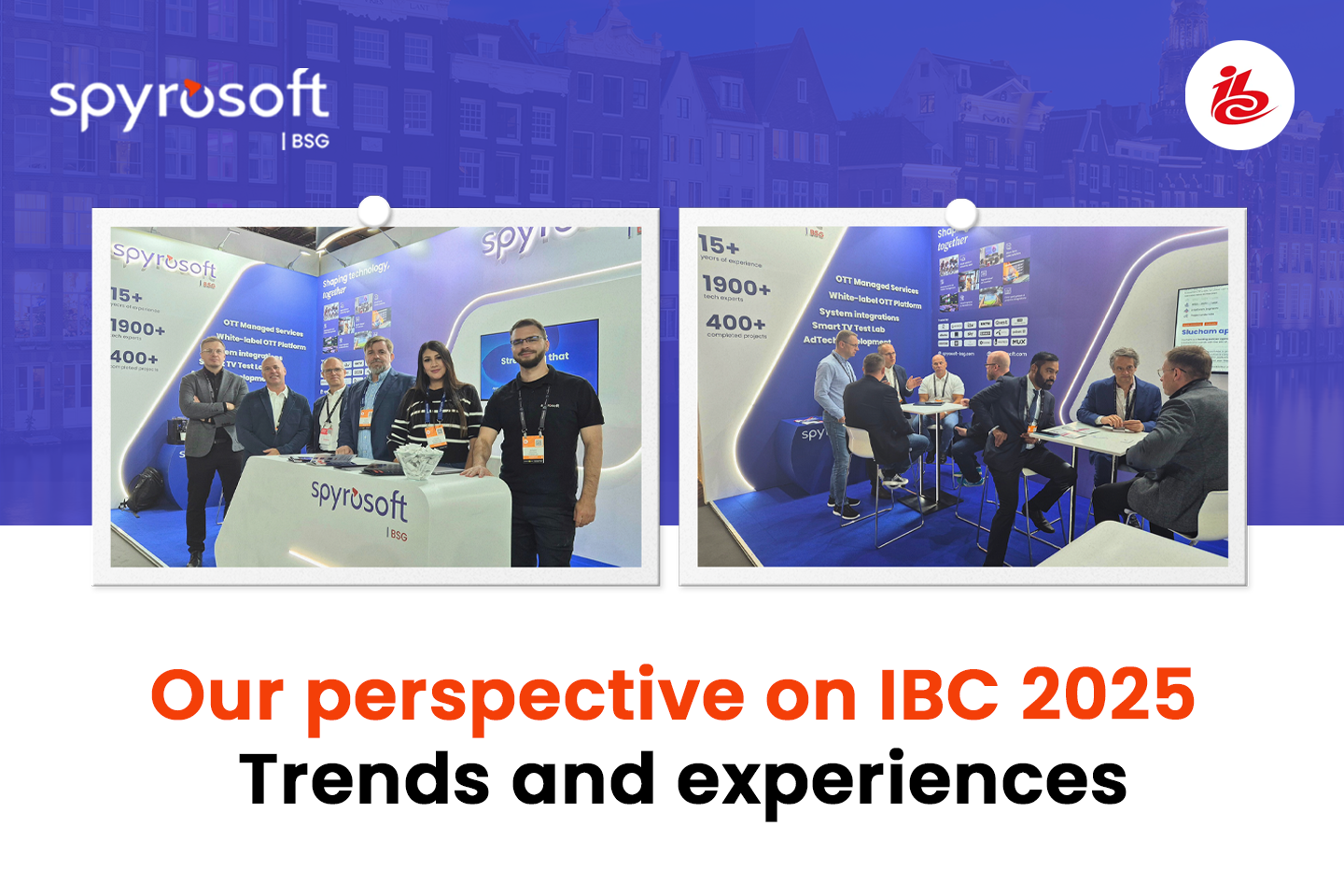
IBC once again brought together broadcasters, streamers and technology leaders to talk about the future of media and entertainment. The event highlighted the big industry shifts: AI and cloud infrastructure, sports, localisation and audience engagement. What was most noticeable was the practical tone of the conversations: innovation is good, but only when it’s real.
At IBC2025, one topic was impossible to avoid: artificial intelligence. But beneath the hype, the conversations were pragmatic: cautious about the technology and focused on tangible gains in operations, monetisation and audience engagement.
AI: promising, but not yet everywhere
Despite dominating the panels and keynotes, AI is not yet an operational tool. Big OTT players said their systems are stable and don’t need AI-driven maintenance. Smaller operators said they can’t justify the cost.
Generative AI is showing promise in test automation and production workflows, but “zero-dev” visions are far away – human oversight is non-negotiable. One Scandinavian operator said automated subtitle generation increased, rather than decreased, editorial workload.
Cloud-first AI solutions are attractive, but integrating with on-prem systems is a major challenge. Vendors offer great pricing models, but migration and operational costs tell a different story.
Perhaps most worrying: piracy and content security are under-prioritised. Many operators treat piracy as a “priced-in risk,” with few investing in watermarking or end-to-end monitoring.
At the same time, some industry voices are genuinely enthusiastic – captivated by AI’s potential to reinvent content creation, personalisation and advertising, even if the path from concept to real-world implementation remains uncertain.
Cloud, scale and speed
If AI got the headlines, cloud infrastructure got the substance. The panels highlighted how regional players, especially in the Baltics and Asia, are thriving by combining cloud-native agility with smart partnerships.
Go3, the largest streamer in the Baltics, has already surpassed Netflix in regional subscriptions. Its success isn’t just about premium sports rights and local originals, but also about infrastructure agility – flexible billing systems and rapid experimentation with monetisation models.
The message was clear: in streaming, the fastest mover wins. Cloud-native architecture lets regional operators move fast, while bigger global players are held back by legacy approval chains.
FAST, DAI and unified workflows
FAST channels and dynamic ad insertion (DAI) have plateaued. Engagement and scale matter more than personalisation. FAST is becoming a bridge to new markets, especially in Asia, where GenAI-powered dubbing and subtitling could unlock reach, but legal barriers persist.
A recurring theme was broadcast and streaming convergence. Unified workflows are emerging to power channels, OTT platforms and FAST together. The idea of a single player supporting all devices may reshape the ecosystem in the next few years.
Sports: from spectators to creators
Sports sessions had some of the most forward-looking conversations. A UEFA x Beyond Sports session showed interactive and personalised viewing: fans could choose camera angles, experience matches from a goalkeeper’s POV, re-skin visuals into Roblox-style graphics or even generate and share their own highlights.
The underlying platform is data- and sport-agnostic, so future applications go beyond football. The trend is clear: fans are no longer passive viewers; they are becoming creators and broadcasters themselves.
Creativity and localisation: AI as an enabler
Sessions with Verbit, Deepdub, and Lightricks highlighted how AI is changing creative and localisation workflows.
- Localisation: AI-driven dubbing promises scalable multilingual delivery, embedding emotive text-to-speech directly into captioning workflows. Yet, human oversight remains essential for cultural accuracy and emotional nuance.
- Creativity: Tools like Lightricks’ LTX Studio demonstrate how AI can support creators at scale, not by replacing artistry but by rethinking how professionals imagine, develop and execute ideas. Open-source multimodal models are enabling editable, coherent, story-first workflows that keep creators in control.
The bigger picture
Across business operations, cloud, advertising and immersive technologies, IBC2025 showed an industry being cautious with innovation.
- Broadcasters and streamers are scaling across regions with productised, modular solutions that deploy quickly and scale easily.
- Standardised outcomes are replacing bespoke builds.
- Cloud, on-prem and hybrid setups remain vital to balancing cost, agility and performance.
Final takeaway
IBC2025 made one thing clear: AI may dominate the headlines, but it hasn’t yet transformed day-to-day operations. The majority of broadcasters and streamers are cautious – experimenting where clear efficiencies exist, holding back where the costs, risks or benefits remain uncertain.
Innovation is welcome, but only when it’s proven, pragmatic and tied to measurable outcomes. For now, the industry is moving forward carefully – choosing stability, reliability and sustainable growth over hype.
If you find this article valuable, you can share it on social media →
Read more about the VOD & OTT Industry!

Is TV Really Dead?
Is TV dead or not? We will try to settle the debate once and for all, discussing the current state of linear TV...

BSG Becomes Roku Development Partner
BSG has earned the status of an official Roku development partner. In this article we detail what it actually means and how we got there.

The ABC of Streaming Services
In a nutshell, streaming services are all about delivering video content over an internet connection to your device or connected TV.
Are you looking for a partner to build a Video Solution?
Leave your email and a short description about your project. We would gladly discuss different cooperation possibilities!