
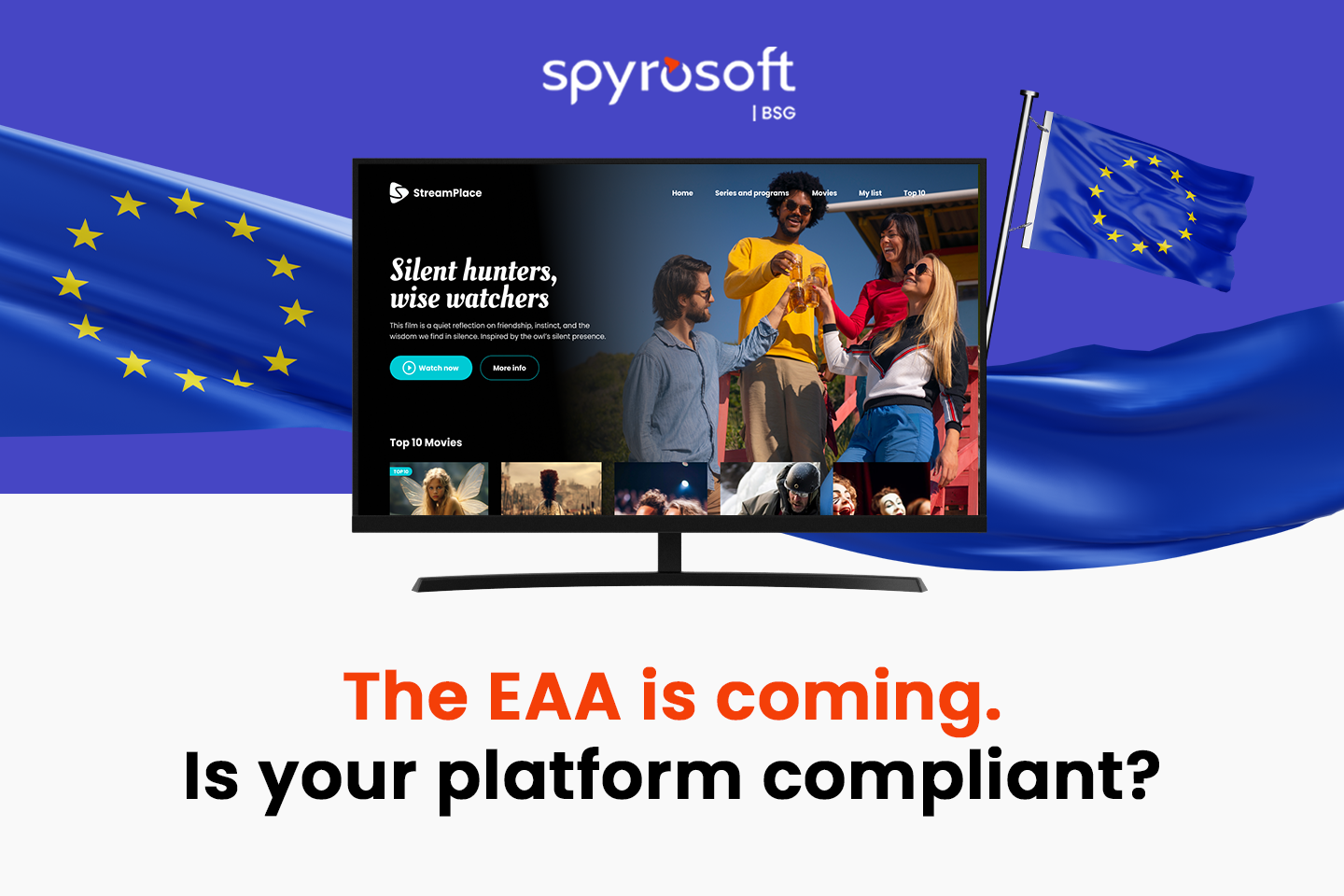
The European Accessibility Act (EAA), set to take effect in June 2025, is about to change the way digital products and services are built across the EU. For media companies, streaming services, and Smart TV app developers, it is a clear push toward greater inclusivity, better user experiences, and staying competitive in the long run.
What is the European Accessibility Act (EAA)?
The European Accessibility Act (Directive 2019/882) aims to harmonise accessibility requirements across EU member states. It covers a wide range of products and services, including:
- Consumer banking services
- E-commerce platforms
- eBooks
- Audio-visual media services
- Consumer hardware and software, including Smart TVs, STBs (Set-Top Boxes), and related applications
The directive focuses on ensuring that people with disabilities, including those with vision, hearing, cognitive, and motor impairments, can use and interact with digital content on an equal footing with others.
Why it matters for streaming and Smart TV apps
With the rise in popularity of video streaming services and Connected TV platforms, media consumption is becoming more app-centric. However, many users still face challenges navigating menus, turning on subtitles, or using the remote control. The European Accessibility Act (EAA) introduces requirements that will bring significant technical and UX changes for companies providing video content via:
- Smart TV apps (Tizen, webOS, Android TV, HbbTV)
- OTT and VOD services
- Live streaming platforms
- On-demand content libraries
- Cross-platform media ecosystems
Key areas of impact
Subtitles and audio descriptions
Under the EAA, platforms must provide captions for pre-recorded and live content, as well as audio descriptions for visually impaired users where applicable. This includes ensuring compatibility with screen readers and supporting voiceover technologies.
User interface accessibility & WCAG 2.2
The EAA is closely aligned with the Web Content Accessibility Guidelines (WCAG), specifically WCAG 2.2. This standard outlines the technical and design requirements to make digital content perceivable, operable, understandable, and robust for users with disabilities.
Apps must allow for easy navigation using assistive technologies, such as screen readers or voice control. Smart TV apps, in particular, need to support:
- Remote navigation and focus indicators
- High-contrast visual modes
- Clear and consistent keyboard interaction patterns
- Avoidance of time-based or motion-only interactions
By complying with WCAG 2.2 Level AA, companies can cover the core accessibility requirements of the EAA.
Consistent and clear interaction patterns
Users must be able to understand and operate the app without unnecessary complexity. That includes logical content structures, consistent navigation, and clear labelling of buttons and controls, especially important on TV screens, where the UI is often more limited.
Accessibility testing across devices
Smart TV platforms such as Tizen, webOS, Android TV, Apple TV, and HbbTV each have unique constraints. Thorough cross-platform testing is needed to validate compliance, especially as some older devices may have limited support for accessibility features.
Technical and business implications
Compliance isn’t optional. By June 28, 2025, all new products and services covered by the directive must meet EAA requirements. This means:
- New development cycles must incorporate accessibility from the ground up
- Existing apps may need to be retrofitted, especially if they are still in wide use
- Testing and certification processes will need to include accessibility audits
- Content providers and app developers must collaborate closely to ensure both infrastructure and UI/UX are compliant
Failure to comply could lead to legal consequences, product recalls, or blocked access to EU markets.
Turn compliance into competitive advantage
While some may see the EAA as just another regulation, forward-thinking companies are treating it as a competitive differentiator. Accessible platforms are more usable for everyone, not just users with disabilities. That means:
- Better UX for aging populations
- Improved voice and gesture controls for smart environments
- Increased brand loyalty and broader audience reach
Moreover, countries outside the EU are watching closely. Accessibility is increasingly seen as a global digital standard – meeting EAA criteria now can prepare your platform for similar regulations in other markets.
What should streaming companies do now?
With the EAA deadline approaching, here are the essential steps to take:
Audit existing platforms: Identify gaps in accessibility against WCAG 2.2 standards across web, mobile, and TV apps.
Design inclusively from the start: Accessibility should be embedded in product design, not added as an afterthought.
Test with assistive technologies: Include screen readers, remote controls, keyboard navigation, and voice input in your QA processes.
Stay informed: EAA requirements may evolve, and national enforcement may vary. Stay in touch with legal and compliance experts.
Partner wisely: Work with technology providers who understand both accessibility and the specific constraints of media and Smart TV development.
Final thoughts
The European Accessibility Act is an opportunity. By prioritising accessibility in streaming and Smart TV app development and aligning with WCAG 2.2 guidelines, media companies can create more inclusive, user-friendly, and future-proof services.
June 2025 is just around the corner. Is your platform ready? We can help!
At Spyrosoft BSG, we specialise in designing, testing, and delivering compliant, accessible media platforms across Smart TVs, web, and mobile. From accessibility audits and inclusive UX design to cross-device testing and implementation – we support you every step of the way.
If you find this article valuable, you can share it on social media →
Read more about the VOD & OTT Industry!
Is TV Really Dead?
Is TV dead or not? We will try to settle the debate once and for all, discussing the current state of linear TV...

BSG Becomes Roku Development Partner
BSG has earned the status of an official Roku development partner. In this article we detail what it actually means and how we got there.

The ABC of Streaming Services
In a nutshell, streaming services are all about delivering video content over an internet connection to your device or connected TV.
Are you looking for a partner to build a Video Solution?
Leave your email and a short description about your project. We would gladly discuss different cooperation possibilities!